








< Blogs

Dropshipping vs Print on Demand – Complete Guide for 2025

Vivan Z.
Created on November 26, 2024 – Last updated on February 6, 20253 min read
Written by: Vivan Z.

In 2025, the e-commerce industry continues to grow rapidly, and Dropshipping and Print on Demand (POD) are two of the most popular business models. Many entrepreneurs often find themselves torn between the two when deciding which type of e-commerce store to start. So, what are the key differences? Which model is better for you? In this article, we will thoroughly compare these two business models, discuss their pros and cons, and help you make a well-informed decision.

What is Dropshipping?

Dropshipping is an e-commerce business model. The retailer doesn’t keep inventory. Instead, they team up with a supplier. When an order comes in, the supplier ships the products straight to the customers. In this model, the retailer focuses on sales and marketing while the supplier takes care of product manufacturing, inventory management, and shipping.

For more details on dropshipping, check out our previous article on What is Dropshipping & How to Start.
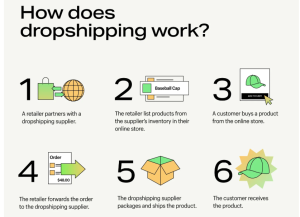
how does dropshipping work

What is Print on Demand?

Print on Demand (POD) is a custom e-commerce model where the retailer does not need to purchase large amounts of inventory upfront. Instead, products are printed and produced only when a customer places an order. This model is often used for custom items like T-shirts, mugs, posters, and more. It allows retailers to offer unique and personalized products without the need for upfront inventory investment.

For more detailed information on Print on Demand, refer to our earlier article on What is Print on Demand? A Beginner’s Guide to the Growing?.

Dropshipping vs Print on Demand: A Comparative Analysis
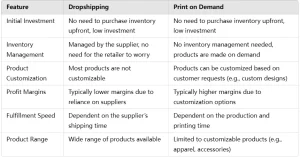
feature Dropshipping

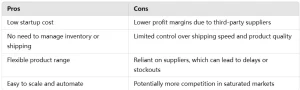
Dropshipping Pros & Cons
Dropshipping Pros&Cons

Print on Demand Pros & Cons


Dropshipping vs Print on Demand: A Comparative Analysis

Which One Should I Choose?

Instead of choosing between dropshipping and print on demand, the goal of this article is to help you gain a deeper understanding of both business models. By reading this guide, you should be able to make an informed decision about which industry or service is the best fit for you. Both models have their unique advantages, and your decision should be based on your business goals, target market, and product offerings.

Conclusion

As we discussed in the Dropshipping Pros section, services like DropSure can help streamline and enhance the dropshipping process. We encourage you to explore your options carefully and choose the model that aligns with your business vision and resources.

Buttom

DropSure is Your Best Partner
22 Years Experience
Affiliate Rebates
100% Quality Guarantee
Top-Up Rewards
10+ Global Warehouses
Custom Branding Support
Smart inventory System
24/7 Customer Support
Get a Quote in 24 Hours
Start Sourcing for Free

Keep Learning

The increasing internal competition and the sharp decline in seller traffic have led many to seek new growth opportunities and channels. Recently, the American e-commerce platform Chewy announced that it is opening its doors to Chinese sellers, offering three cooperation models for sellers to choose from: Dropship, Procurement , and Import. Among these, the Dropship model is similar to Temu’s semi-managed model, where sellers are required to maintain inventory in the U.S., while Chewy sets the prices and handles logistics, with sellers only needing to supply the goods. Over the course of its development, the cross-border e-commerce industry has given rise to a variety of outbound models: from the initial policy regulation model, to later fully-managed platforms, independent sites/DTC, industrial cluster collaborations, and even comprehensive ecological outbound expansion. The approaches have become increasingly diverse as the market environment evolves. In response to the various outbound models prevalent in today’s cross-border e-commerce industry, we will compare and analyze the different models. Platform E-commerce Models For the majority of sellers, especially newcomers and beginners in the cross-border e-commerce industry, relying on third-party platforms such as Amazon, Temu, AliExpress, Shopee, and others is a common approach. These platforms provide essential traffic and infrastructure support. Let’s take Amazon and Temu as examples: Amazon Platform Model  To enhance the trustworthiness and visibility of your products, you can apply for A+ Content certification or establish a dedicated Brand Store. These features allow you to present your brand more professionally, potentially increasing conversion rates. However, these services are not free; you need to invest in them. Additionally, Amazon charges a referral fee, typically ranging from 6% to 15% of the product’s selling price, depending on the category. […]

If you’re running an online store or just starting to build your e-commerce business, product selection is the most crucial (and time-consuming) decision you’ll make. Choose the right products, and your store will thrive like a rocket-powered success; choose the wrong ones, and you might end up with unsold inventory, wasted ad spend, and painful clearance sales. Product selection isn’t just about picking what looks good—it requires strategy, data analysis, and a keen market sense. Today, we’ll break down the complete product selection process to help you avoid pitfalls and find truly profitable products for your store! Step 1: Define Your Store’s Positioning to Stay on the Right Track!  Before Selecting Products, Ask Yourself: What Do You Want to Sell? Choosing winning products isn’t about picking something that “looks good.” It requires a clear direction and strategy. Your store’s business model directly affects your product selection approach. If you pick the wrong model, marketing and operations can become unnecessarily difficult. Here are three common store models and their ideal product selection strategies: One-Product Store: Scale a Winning Product to the Top This model focuses on a single high-demand product, using targeted marketing and aggressive advertising to dominate the market. The key is finding a problem-solving product with high demand and manageable competition, then pushing it through Facebook, Google Ads, or TikTok for rapid growth. Best Products for One-Product Stores: ● Functional products that solve a clear pain point (e.g., neck massager, smart water bottle) ● Trendy items with rising social media interest (e.g., TikTok and Instagram viral products) ● Unique, eye-catching products that spark curiosity (e.g., LED sneakers, automatic stir-fry machine) Caution: This model is high-risk. Once ads stop, sales […]

Have you started your dropshipping business yet? Or are you still stuck trying to decide which platform is the best fit for you? Don’t worry—choosing a supplier and fulfillment platform is kind of like finding your perfect match. Get it right, and everything runs smoothly. Get it wrong? You might find yourself wishing for a “return policy.” Here’s the good news: there are plenty of excellent dropshipping platforms out there, like DropSure and CJdropshipping. Each has its strengths, but figuring out which one is your perfect match takes a little comparison (don’t worry, we’ve done the heavy lifting for you). In this post, we’ll break things down by price, platform integration, product selection, order processing, shipping speed, customer support, and overall user experience. Whether you’re just starting out or you’re a seasoned pro, by the end of this, you’ll know exactly which platform deserves your business. Ready? Let’s dive in! What is DropSure? DropSure is your all-in-one solution. It is tailored for busy e-commerce sellers like you. Tired of stressing over inventory? Losing sleep over shipping delays? Or maybe you’re struggling to find reliable suppliers? Don’t worry—DropSure can meet all your needs! From product sourcing to order fulfillment to logistics, we handle everything so you can focus on what you do best: making money. With 22 years of industry expertise under our belt, DropSure know what it takes to make your business thrive. Backed by a team of 200+ professionals and 7 placed warehouses (in China, the U.S., Germany, and more), we ensure your orders reach customers at lightning speed. Oh, and product catalog? It’s massive—over 1 million high-quality items to choose from, so you’re bound to find your next […]