








< Blogs

Dropshipping vs Print on Demand – Complete Guide for 2025

Vivan Z.
Created on November 26, 2024 – Last updated on February 6, 20253 min read
Written by: Vivan Z.

In 2025, the e-commerce industry continues to grow rapidly, and Dropshipping and Print on Demand (POD) are two of the most popular business models. Many entrepreneurs often find themselves torn between the two when deciding which type of e-commerce store to start. So, what are the key differences? Which model is better for you? In this article, we will thoroughly compare these two business models, discuss their pros and cons, and help you make a well-informed decision.

What is Dropshipping?

Dropshipping is an e-commerce business model. The retailer doesn’t keep inventory. Instead, they team up with a supplier. When an order comes in, the supplier ships the products straight to the customers. In this model, the retailer focuses on sales and marketing while the supplier takes care of product manufacturing, inventory management, and shipping.

For more details on dropshipping, check out our previous article on What is Dropshipping & How to Start.
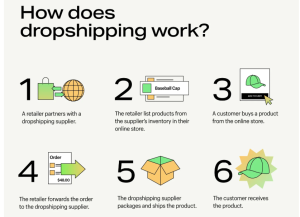
how does dropshipping work

What is Print on Demand?

Print on Demand (POD) is a custom e-commerce model where the retailer does not need to purchase large amounts of inventory upfront. Instead, products are printed and produced only when a customer places an order. This model is often used for custom items like T-shirts, mugs, posters, and more. It allows retailers to offer unique and personalized products without the need for upfront inventory investment.

For more detailed information on Print on Demand, refer to our earlier article on What is Print on Demand? A Beginner’s Guide to the Growing?.

Dropshipping vs Print on Demand: A Comparative Analysis
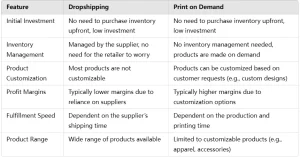
feature Dropshipping

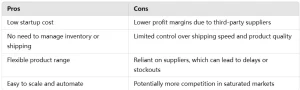
Dropshipping Pros & Cons
Dropshipping Pros&Cons

Print on Demand Pros & Cons


Dropshipping vs Print on Demand: A Comparative Analysis

Which One Should I Choose?

Instead of choosing between dropshipping and print on demand, the goal of this article is to help you gain a deeper understanding of both business models. By reading this guide, you should be able to make an informed decision about which industry or service is the best fit for you. Both models have their unique advantages, and your decision should be based on your business goals, target market, and product offerings.

Conclusion

As we discussed in the Dropshipping Pros section, services like DropSure can help streamline and enhance the dropshipping process. We encourage you to explore your options carefully and choose the model that aligns with your business vision and resources.

Buttom

DropSure is Your Best Partner
22 Years Experience
Affiliate Rebates
100% Quality Guarantee
Top-Up Rewards
10+ Global Warehouses
Custom Branding Support
Smart inventory System
24/7 Customer Support
Get a Quote in 24 Hours
Start Sourcing for Free

Keep Learning

In domestic business, we’re used to communicating via WeChat — sending messages, making voice calls, or even solving problems with a screenshot or voice message anytime and anywhere. It’s convenient and efficient. Financial reconciliations might be stored in a folder somewhere, and contracts are often exchanged in PDFs or through “oral confirmation.” This way of doing business works well in familiar circles and local markets because it’s fast and flexible. But once you step into the world of cross-border e-commerce, especially after registering a company in the U.S., many things are no longer just a matter of “habits,” but of standards, systems, and compliance. You’ll be dealing with English emails, overseas banks, Stripe settlements, correspondence from U.S. state governments, and those dreaded IRS tax forms. Tax issues, especially tax compliance, will become crucial to whether you can operate long-term, make continuous profits, and receive payments legally. Why is Tax Compliance So Important? If you’ve just registered a company in the U.S., you might be most concerned about quickly getting your products listed, running ads, and receiving payments. As for “tax filing,” you may have temporarily put it aside, thinking, “I’ll deal with it once I start making money.” But sorry, this isn’t something that only shows up after you make money — it actually starts the moment you register your company. The U.S. tax system is notoriously complex. It’s not just about federal taxes — states, and even some cities, can impose their own taxes, and they’ll come after you individually. What’s even more “terrifying” is that the U.S. tax authorities are known worldwide for being meticulous. The IRS is like an insomniac “data machine” that, once you register your […]

Ever felt the thrill of waiting for a package, only to wonder where it is? We’ve all been there. For e-commerce sellers and everyday shoppers, tracking a shipment is like watching the journey of a tiny traveler. USPS tracking is your trusty guide. In this blog, we’ll decode tricky statuses like “label created not yet in system” and “in transit to next facility,” and share tips to make tracking easier. Stick around, we’ve got you covered! What is USPS? The United States Postal Service, or USPS, has a rich history that dates back to 1775. It began as a service to connect the American colonies, delivering letters and official documents during a time when reliable communication was a luxury. Fast forward to today, USPS has become one of the most recognized and trusted names in the world of mail and logistics. It’s not just about delivering letters anymore—it’s about connecting people and businesses across the globe with speed and efficiency. A Brief History of USPS USPS was officially established by Benjamin Franklin, who became the first Postmaster General. Back then, its mission was simple: to ensure that letters and packages could reach every corner of the newly formed United States. Over the centuries, USPS has adapted to the changing needs of society. From horse-drawn carriages to planes and advanced logistics networks, it has always embraced innovation to stay relevant. Despite the rise of digital communication, USPS remains an essential service, handling billions of pieces of mail each year. USPS Service Offerings USPS offers a variety of services tailored to meet different needs. Here’s what they provide: Mail Services USPS is known for its standard mail delivery options, designed for personal […]

In 2025, the e-commerce industry continues to grow rapidly, and Dropshipping and Print on Demand (POD) are two of the most popular business models. Many entrepreneurs often find themselves torn between the two when deciding which type of e-commerce store to start. So, what are the key differences? Which model is better for you? In this article, we will thoroughly compare these two business models, discuss their pros and cons, and help you make a well-informed decision. What is Dropshipping? Dropshipping is an e-commerce business model. The retailer doesn’t keep inventory. Instead, they team up with a supplier. When an order comes in, the supplier ships the products straight to the customers. In this model, the retailer focuses on sales and marketing while the supplier takes care of product manufacturing, inventory management, and shipping. For more details on dropshipping, check out our previous article on What is Dropshipping & How to Start. What is Print on Demand? Print on Demand (POD) is a custom e-commerce model where the retailer does not need to purchase large amounts of inventory upfront. Instead, products are printed and produced only when a customer places an order. This model is often used for custom items like T-shirts, mugs, posters, and more. It allows retailers to offer unique and personalized products without the need for upfront inventory investment. For more detailed information on Print on Demand, refer to our earlier article on What is Print on Demand? A Beginner’s Guide to the Growing?. Dropshipping vs Print on Demand: A Comparative Analysis Dropshipping Pros & Cons Print on Demand Pros & Cons   Dropshipping vs Print on Demand: A Comparative Analysis Which One Should I Choose? Instead […]
Recommended for you

Error: cURL error 28: Operation timed out after 5002 milliseconds with 0 bytes received